
Fish
Until recently, fish had not been reported in the park for a very long time (if ever.) But thanks to a collaboration with the Native Fish Coalition (NFC) and Newton Conservators, two species of fish have been discovered.
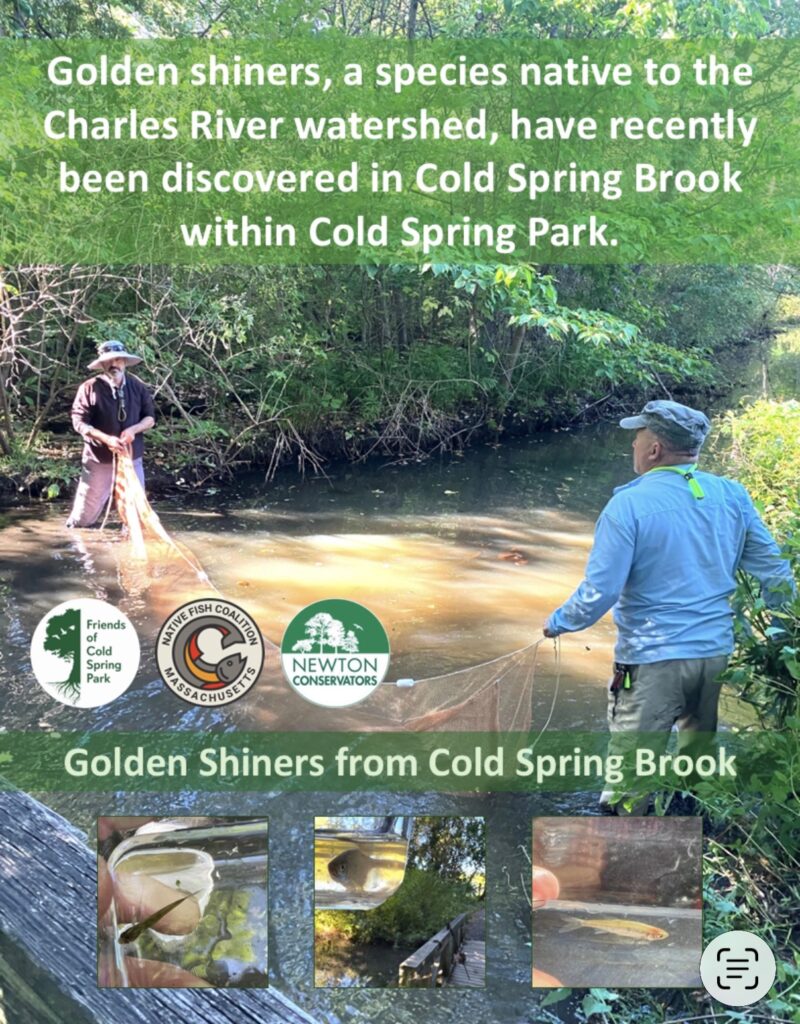
The golden shiners have since been captured in other locations, with further identification by environmental DNA analysis. Because they are a common bait fish, the shiners most likely were placed in the brook after someone was done fishing. Because of varying sizes and age classes, however, it appears that they have established a self-sustaining small population.
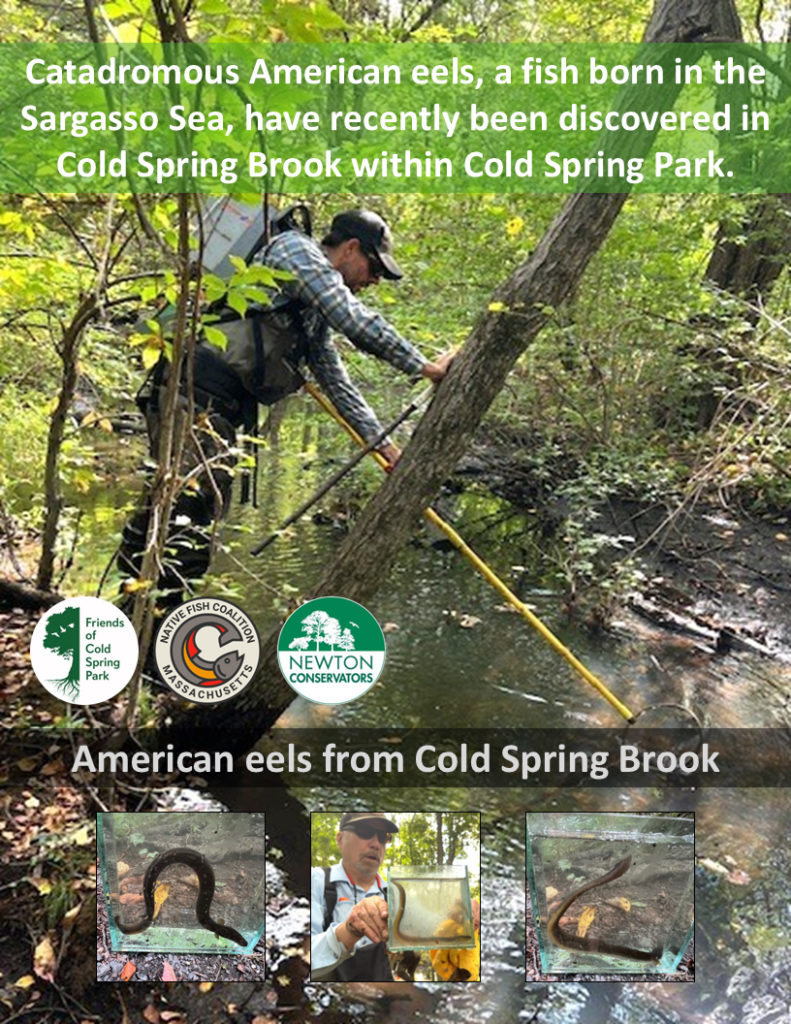
The NFC enlisted the help of state Fish & Game specialist Adam Kautza to do an electro-fishing expedition in the brook. E-fishing delivers a small shock that temporarily stuns fish and floats them to the surface to be captured, positively identified, and released. They fully recover in less than a minute and are unharmed.
Two American eels were surfaced, one about 18″, pictured here, and one about 24″, that was netted but got away before it could be captured. American eel has an amazing life cycle. They are born in the Sargasso Sea, out in the Atlantic Ocean, and travel by currents and swim hundreds of miles to travel up freshwater streams, where they can live for decades, before returning to the Sargasso Sea to spawn.
We are grateful to the NFC for conducting extensive exploration with us of the brook history and habitat in the park, as well as downstream in the Newton Cemetery, and City Hall ponds. There, Cold Spring Brook joins with Hammond Pond to enter Bulloughs Pond, and then proceed as Laundry Brook to the Charles River.
In addition to netting and trapping fish, they examined old maps, measured temperature changes in the brook from spring to fall, and dissolved oxygen levels.
Sadly, the brook habitat is in very poor condition. Cold Spring Brook was moved from its original location into straightened channels in order to drain what was originally a swamp, and create the park. We plan to incorporate efforts to improve the health of the brook habitat into our ongoing work at Cold Spring Park.